English

English
Overview:
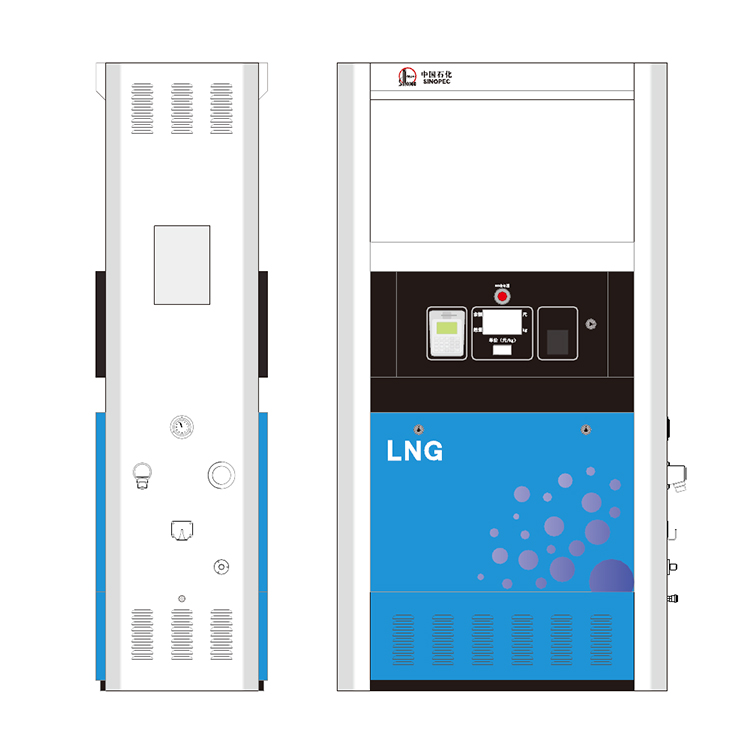
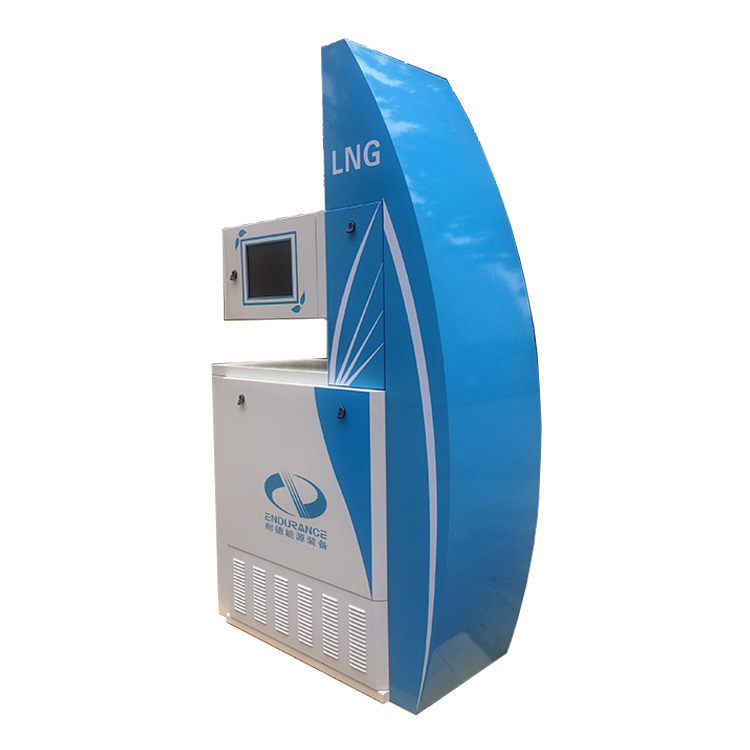
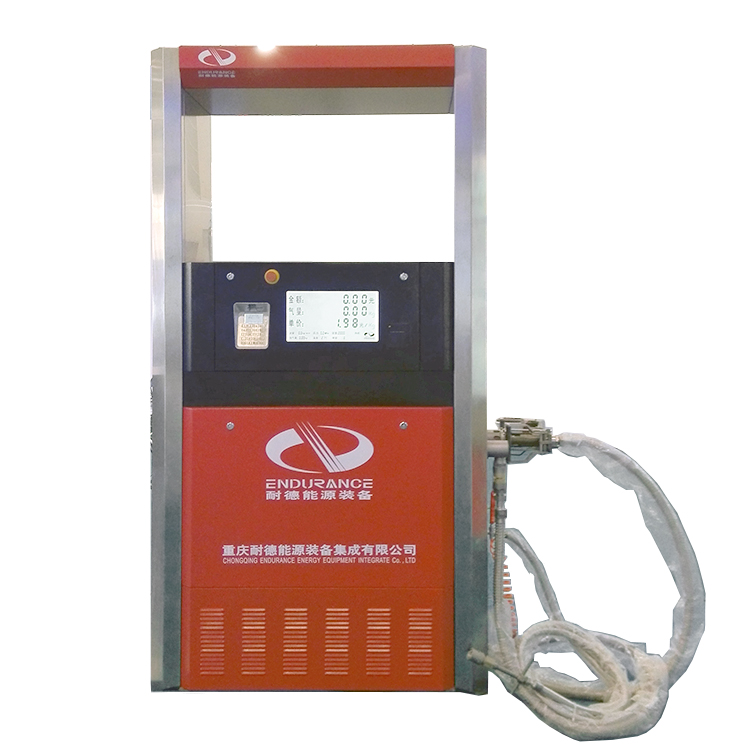
Endurance high flow LNG dispenser has integrated high performance industrial controlled computer head and high accuracy mass flow meter. All valves and internal parts has passed strict cryogenic test to ensure safe operation. LNG dispenser designed to refuel LNG powered trucks in a safer, easier and more ergonomic way.
Working Principle:
LNG from LNG tank enters into LNG dispenser through pipeline and flows through mass flow meter, cryogenic pneumatic valves, liquid flexible hose, LNG coupling nozzle, and is filled into LNG cylinder. Liquid Mass flow meter will meter parameters of gas such as density and mass.
Excess BOG gas inside LNG cylinder will be returned back to LNG station system through gas nozzle, gas flexible hose, gas phase mass flow meter (optional), cryogenic check valve, recycle piping. Gas phase mass flow meter will meter parameters of BOG gas such as density and mass.
Data from both flow meters will be transmitted to computer controller, and computer controller will deduct the amount metered by gas phase flow meter from the amount metered by liquid phase flow meter, and displays result to operators and consumers through LCD screen.
Computer controller will provide dynamic monitoring of the status of liquid phase flow meter. In case the liquid temperature, gas and liquid conditions, density etc cannot meet the filling requirement, the system will start pre-cooling automatically through recycling until it meets the filling requirements. Schematic flow diagram is illustrated below.
Features:
Ø Multilevel safety measures for over pressure, excess flow, breakaway protection, manual emergency shut-off, etc.
Ø Data protection and display during power cut off.
Ø Automatic error diagnosis for data distortion and fault.
Ø Cumulative and periodical data background lookup available.
Ø Simultaneous monitoring for pressure, temperature and flow rate during filling process.
Ø Pressure and temperature compensation from mass flow meter.
Ø Preset fixed amount/volume filling control.
Ø Online drainage design of filters.
Ø Pressure release and sewage blow-down design.
Ø Manual fast filling available.
Ø Automatic stop when filling quantity reaches designed pressure.
Ø Large memory storage capacity.
Ø Thousands of recent filling record available for checking.
Precautions:
Precautions for Using High Flow LNG Dispenser:
1. Check Instrument Air Pressure:Before powering up the dispenser, ensure that the instrument air pressure is adequate (>0.4 MPa).
2. Check the Small Circulation Valve:After powering up the dispenser, the small circulation valve should actuate, except in special settings. The display should show the data from the last refueling, and the screen next to the keypad should indicate that the dispenser is idle.
3. Minimize Large Circulation Pre-cooling:Minimize the number of large circulation pre-cooling cycles as much as possible. This can be determined based on defrosting conditions or ambient temperature. When the ambient temperature is high, it is advisable to increase the number of large circulation cycles as needed.
4. Maintenance of the Flowmeter: The flowmeter is a mass flow meter. Its solid parts are not under vacuum, and the interior is filled with inert gas, which may frost over long periods of operation. It is not recommended to insulate the flowmeter, as this may affect measurement accuracy.
5. Use of the Dispenser Nozzle: Prior to each operation, the dispenser nozzle should be purged, especially around the internal sealing ring, to prevent ice debris and foreign matter from damaging the seal. During operation, use both hands to apply balanced force, relieve the pressure first, and then gently pull out the handle.
6. Handling of Static Electricity: LNG is a flammable gas, so smoking, open flames, and non-explosion-proof electrical equipment are prohibited in LNG storage, transportation, and production areas. LNG dispensers are equipped with static grounding lines. Ensure that the vehicle is grounded to the earth during refueling to avoid static electricity buildup.
7. Maintenance of Equipment and Pipelines: Regular maintenance and inspection of equipment and pipelines at the refueling station are required to ensure proper operation. Vehicles also need regular checks of the fuel system to ensure there are no leaks.
Specification
Flow range | 6~80kg/min/hose |
Hose quantity | Single hose, Dual hoses |
Batch Accuracy | +1.5% |
Nominal working pressure | 1.6MPa |
Ambient Temperature | -25℃~+55℃ |
Pipeline Temperature | -196℃~+55℃ |
Ambient humidity | ≤95% |
Ambient atmosphere pressure | 86~110KPa |
Measuring Unit | Kg, L or Nm3 |
Minimal Reading | 0.01 |
Single counting range | 0~9999.99 |
Accumulative counting range | 0~99999999.99 |
Working Power | 100W for single nozzle model |
Measuring Unit | Kg or Nm3 |
Minimal Reading | 0.01 |
Refuel hose | 1 inch, 4m SShose |
Gas-return hose | 1/2inch, SShose |
LNG refuel coupling | 1 inch |
Gas phase coupling | 1/2 inch |
Power supply | 220V+10% ,50Hz±1Hz -15% |
Explosion-proof Grade | ExdeibmbⅡAT4 Gb, CE, ATEX |
Working Power | Single hose 150W Dual hoses 250W |